Grid Royale
Duel (2p)Free-for-all (4p)Free-for-all, large field (4p)
+ New botPlay built-insArenaTournamentsAI codingLeaderboardRulesMatches
Leaderboard
Duel (2p) · 2 players · how ranking works


Rules
Objective
Grid Royale is a resource-economy battle royale on a square grid. Each player commands units that harvest ore from cells, carry it home, and bank it. Banked ore is your score. Carried ore is at risk: a unit that dies drops its cargo and scores nothing. A border closes inward over the match, forcing players together until contact decides it. Highest bank at the end wins.
Everything is integer arithmetic over a seeded state, so a match is fully deterministic: the same seed and the same actions always produce the same result, and any replay re-runs identically.
The board
- A square grid. Side length depends on player count: 24×24 for 2 players, 32×32 for 4.
- Each cell holds a non-negative integer ore amount. Ore does not regenerate.
- A safe zone is a square region, initially the whole board, that shrinks inward over the match. Cells outside it are lethal.
- Each player owns one base cell, fixed for the match, where units bank ore and new units spawn. Bases sit inside the smallest the safe zone ever gets, so a base is never swallowed by the border.
Units, bases, banks
- Unit — belongs to one player, has a position and an integer
cargo(0 tocargo_cap). Each player starts with one unit on its base, cargo 0. - Base — one per player, fixed cell.
- Bank — your score, an integer. Only banked ore counts; carried cargo does not.
A turn
Turns are simultaneous. Every player submits an action batch: at most one order per unit it owns, plus an optional base spawn. All batches are collected, then resolved together. No player sees another's order for that turn before submitting.
A unit order is one of: MOVE_N, MOVE_E, MOVE_S, MOVE_W, or STAY. A unit with no order defaults to STAY.
How a turn resolves
One turn resolves in fixed phases. Within a phase, every effect reads the state from before that phase, so the result never depends on unit order.
- Move. For each unit with a
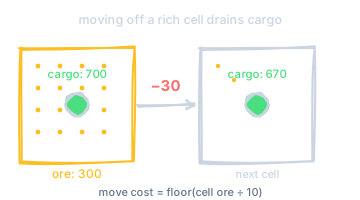
MOVE_*order, the move costsfloor(source_cell_ore / move_cost_divisor)from cargo. If the unit can afford it, the cost is deducted and the unit moves one cell. If it cannot afford it, the unit stays put and does not harvest this turn (it spent the turn trying to move). Moving off a rich cell is expensive on purpose. - Collision. Any cell holding two or more units destroys all units on it, and their combined cargo spills onto that cell as ore. Exception: two or more units of the same owner on that owner's base are not a collision; they bank and survive. Any mix of owners on a cell, including on a base, is a collision.
- Harvest. Each surviving
STAYunit that is not on its own base harvestsfloor(cell_ore / harvest_divisor)from its cell into cargo, capped by remaining cargo space. - Bank. Each surviving unit on its own base adds its full cargo to your bank and resets cargo to 0. The unit stays.
- Spawn. If you ordered a spawn, can afford
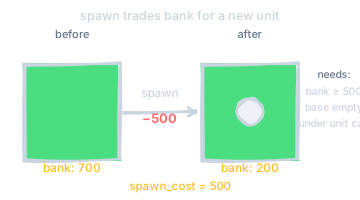
spawn_cost, are under theunits_cap, and have no own unit sitting on your base, a new unit appears on your base with 0 cargo andspawn_costis deducted from your bank. - Border. On a shrink turn (every
shrink_intervalturns) the safe zone contracts inward by one ring, down to themin_zonefloor. Any unit then outside the safe zone is destroyed and its cargo is lost (not spilled).
Combat
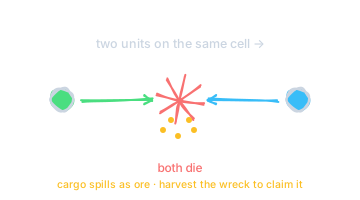
There is no attack order. You kill an enemy by colliding with it, which kills your unit too. The cargo spills onto the cell, so ramming a loaded enemy hands the ore to whoever harvests the wreck next. Defending a laden unit on its way home, and judging when a trade is worth a unit, is most of the mid-game.
Banking and spawning
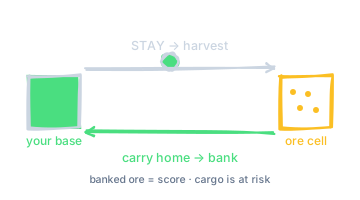
- Banking is a round trip: harvest out, carry home, deposit. A longer trip means more ore exposed to collision and the border.
- Spawning trades present bank for future gathering: more units gather more, but collide more and cost more to move.
The closing border
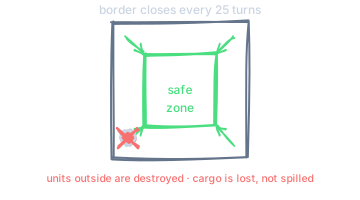
The border is the only place ore leaves the game. Cargo lost to it does not spill. That is what makes the late game tighten rather than spiral.
When the match ends
The match ends when the turn count reaches max_turns, or when at most one player is not eliminated. A player is eliminated when it has zero units and a bank below spawn_cost (it can never act again); a player with zero units but enough bank to spawn is still in.
Placement is a strict order: higher final bank first, then more units alive, then banked-earlier, then lower seat index.
Fair starts
The ore map is generated from the match seed with rotational symmetry matching the player count, so every player begins in a position identical to every other up to rotation. No seat is luckier; outcomes come from play, not the draw.
What your bot sees
Each turn your bot receives the full observation as JSON (no hidden information at this version):
{
  "turn": 41,
  "max_turns": 400,
  "you": 0,
  "width": 32,
  "height": 32,
  "safe_zone": { "x0": 4, "y0": 4, "x1": 27, "y1": 27 },
  "ore": [[0, 12, 0, "..."], "..."],
  "bases": [{ "owner": 0, "x": 8, "y": 8 }, "..."],
  "banks": [10240, 9980, "..."],
  "units": [{ "id": 12, "owner": 0, "x": 9, "y": 8, "cargo": 740 }, "..."],
  "params": { "cargo_cap": 1000, "spawn_cost": 500, "move_cost_divisor": 10, "harvest_divisor": 4, "units_cap": 50 }
}
ore is row-major: ore[y][x].
What your bot returns
{
  "orders": [
    { "unit": 12, "do": "MOVE_N" },
    { "unit": 15, "do": "STAY" }
  ],
  "spawn": true
}
spawn is optional. A unit you do not mention defaults to STAY, so a minimal bot still harvests.
Limits
Three independent limits decide how much a unit can do per turn:
| Limit | Setting | Notes |
|---|---|---|
| Action | one order per owned unit, one optional spawn | enforced by the engine |
| Fuel per turn | 5,000,000 instructions, bank up to 20,000,000 | the competitive compute budget for bots |
| Wall-clock | 2,000 ms per turn | liveness backstop; a breach is an operational forfeit |
Fuel is metered, hardware-independent instruction counting: a search-everything bot hits the ceiling mid-search and must act on what it found. Exhausting fuel, timing out, or returning an illegal action is a no-action turn (your units default to STAY).
Parameters
| Parameter | Value |
|---|---|
| grid side (2p / 4p) | 24 / 32 |
| players | 2 or 4 |
| cargo_cap | 1000 |
| harvest_divisor | 4 |
| move_cost_divisor | 10 |
| spawn_cost | 500 |
| units_cap | 50 per player |
| max_turns | 400 |
| shrink_interval | 25 turns |
| min_zone | 8×8 (always contains all bases) |
Edge cases
- Two of your own units onto the same non-base cell collide and both die. Routing around your own units is part of the skill.
- A unit that cannot afford a move stays without harvesting; a stuck move is a wasted turn.
- A spawn onto an occupied base is blocked that turn and the bank is not charged.
- Cargo on a unit destroyed by the border is lost, not spilled.
Recent matches
Duel (2p)


